For Buy Here Pay Here (BHPH) dealerships, assigning a vehicle to an outside recovery agent should be simple.
But traditional repo coordination can require multiple steps: creating a user, assigning access, generating a ticket, and making sure the recovery agent has the information needed to move forward.
When a vehicle already needs recovery, those extra administrative steps can slow the process down.
That is why Sarekon introduced Quick Repo.
Quick Repo brings repo ticket creation, temporary recovery user setup, and emailed access into one streamlined workflow. For newly created temporary recovery users, the agent receives a direct access link by email and can open the assignment without creating a username or password or signing in separately.
For dealerships managing one-off or individual repos, that means fewer setup steps, easier handoffs, and more control over temporary recovery access.
Collections teams already have enough to manage.
When an account moves into recovery, employees may be balancing customer communication, payment follow-up, vehicle location, and coordination with outside recovery agents.
Quick Repo is designed to make one part of that process easier.
Instead of treating user creation, ticket setup, and access delivery as separate administrative tasks, dealerships can handle them within one workflow.
That simplicity matters most when an outside recovery agent needs access quickly.
One of the biggest advantages of Quick Repo is the temporary access experience.
When a dealership creates a new temporary recovery user, Sarekon automatically emails that agent a direct link to the assignment.
The temporary user does not need to create a username or password or complete a separate sign-in process before accessing the link.
That removes another step between assigning the repo and getting the recovery agent the information they need.
Quick Repo also gives dealerships control over how long temporary recovery access remains available.
By default, the repo ticket and associated access link expire 30 days after creation.
However, the employee creating the ticket can select a different duration from the expiration dropdown menu.
This allows the dealership to determine how long the temporary recovery agent should have access based on the assignment.
The result is a simpler handoff without giving temporary access indefinitely.
For dealers who want to understand the exact workflow, Quick Repo can be created directly through Sarekon’s Admin platform.
Navigate to:
Admin > Trackers > Select Vehicle > New Repo Ticket
The Assign To field defaults to Create New User, allowing the dealership to create a temporary recovery user while opening the repo ticket.
If the recovery agent is already an existing Sarekon user, the employee can select that user directly from the dropdown instead.
The automatic email link and password-free temporary access process described in this article apply specifically to newly created temporary recovery users.
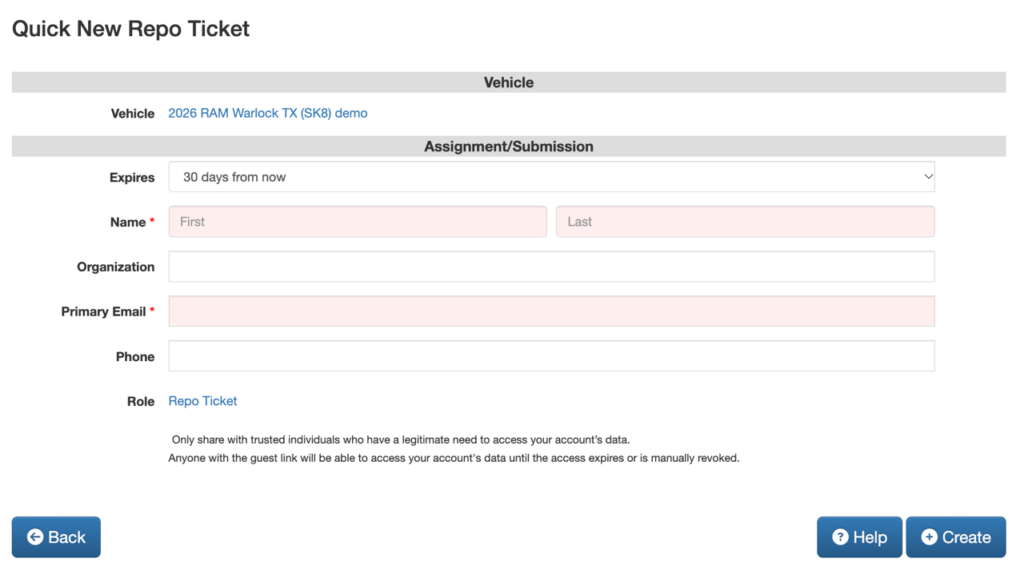
For a new temporary recovery user, the dealership enters:
The employee also controls the assignment’s expiration period.
By default, the repo ticket and associated temporary access link expire after 30 days, but another duration can be selected from the expiration dropdown.
Once the employee clicks Create, Sarekon emails the newly created temporary recovery user a direct access link.
The recovery agent can use that temporary link without setting up separate login credentials or signing in.
Instead of creating the user, generating the ticket, and delivering access through separate processes, Quick Repo brings those steps together.
Quick Repo is not about making the recovery process more complicated with another feature.
It is about removing unnecessary steps from a process BHPH dealerships already handle.
For dealerships working with outside recovery agents, that can mean:
Less Administrative Setup
Create the repo ticket and temporary recovery user in one workflow.
Faster Handoffs
Send a newly created temporary recovery agent direct access by email without requiring separate login setup.
Controlled Temporary Access
Choose how long the repo ticket and associated link remain available.
More Time for Collections
Spend less time setting up one-off repo assignments and more time managing the portfolio.
Locating a financed vehicle is only one part of recovery.
Once the decision to move forward has been made, the dealership still needs a practical way to assign the vehicle, provide access, and coordinate with the recovery agent.
Quick Repo is designed around that operational reality.
For a one-off repo, dealerships should not need to build a complicated user setup process just to give a recovery agent temporary access to an assignment.
One vehicle. One repo ticket. One simpler handoff.
Quick Repo is a simplified repossession workflow that allows BHPH dealerships to create a repo ticket and a new temporary recovery user within the same process.
Once created, the temporary user receives a direct access link by email.
No.
A newly created temporary recovery user receives a direct access link by email and does not need to create a separate username or password or sign in before accessing the assignment through that link.
Yes.
If the recovery agent already exists in Sarekon, the employee can select that user from the Assign To dropdown instead of creating a new temporary user.
The direct temporary access link and no-login workflow apply specifically to newly created temporary recovery users.
By default, the repo ticket and associated access link expire 30 days after creation.
The employee creating the ticket can select a different expiration period from the dropdown menu, giving the dealership control over how long the temporary recovery agent has access.
When a vehicle needs to move into recovery, your team should not have to spend unnecessary time setting up temporary users and coordinating access.
Sarekon Quick Repo brings repo ticket creation, temporary recovery user setup, access delivery, and expiration controls into one streamlined workflow.
Fewer setup steps. Easier handoffs. More control over temporary access.
Sarekon.com | (888) 726-3511
5 ways to protect your trailers and equipment before the holiday weekend.
As Thanksgiving approaches, businesses are preparing for reduced hours, holiday closures, and valuable equipment sitting unattended for several days.
For trailer dealers, contractors, and equipment rental companies, a stolen trailer can create problems far beyond its replacement cost. Missing equipment can delay jobs, interrupt deliveries, disrupt operations, and create significant financial losses.
And when a trailer disappears during a holiday closure, businesses may not discover the problem until employees return.
Your business may close for the holidays, but protecting your equipment shouldn’t take a break.
Before closing for Thanksgiving or an extended holiday weekend, take these steps to help protect your inventory and equipment.
1. Verify Equipment Locations
Account for trailers and equipment across dealerships, storage yards, and job sites. Knowing where each asset is parked makes it easier to identify unexpected changes.
2. Check Your GPS Devices
Confirm that your GPS-equipped assets are reporting as expected. Review battery levels, power connections, and device settings before leaving equipment unattended.
3. Set Movement Alerts and Geofences
Establish geofences around storage facilities, dealerships, or job sites. With a properly configured Sarekon GPS device, businesses can receive notifications when a tracked trailer is reported outside a designated area.
4. Secure Unattended Equipment
Use trailer locks, secure storage areas, adequate lighting, and other physical security measures alongside GPS tracking.
5. Prepare Your Recovery Plan
Make sure the appropriate employees know how to access GPS location information and who to contact if equipment goes missing.
A few minutes of preparation before a holiday shutdown can help reduce uncertainty and make it easier to respond if something unexpected happens.
Imagine closing your trailer dealership or equipment yard for Thanksgiving weekend. Your employees leave, the gates are locked, and operations won’t resume for several days.
But what happens if a trailer is moved unexpectedly during that time?
Without GPS visibility, your team might not discover the missing equipment until the next business day.
Sarekon GPS tracking helps businesses monitor asset locations and identify unexpected movement, even when employees aren’t physically on-site.
With Sarekon, businesses can:
For example, a trailer dealer can establish a geofence around a storage lot before Thanksgiving. If a GPS-equipped trailer moves outside that area and the device reports its new location, the system can generate an alert.
This information may help the business identify unexpected activity and begin investigating sooner, rather than discovering the problem after the holiday weekend.
Important: Location reporting and alert timing depend on the selected device, configuration, reporting intervals, battery condition, operating mode, and cellular connectivity. Not all GPS devices provide continuous real-time tracking or immediate movement notifications.
Not every trailer operates under the same conditions.
Some trailers have access to external power, while others remain parked for weeks or months without a reliable power source.
Sarekon offers flexible GPS hardware options to accommodate different tracking requirements.
Wired GPS Devices
Designed for compatible assets with an available power connection, wired devices can provide ongoing tracking without relying solely on an internal battery.
Non-Rechargeable Battery-Powered GPS Devices
These wireless devices operate on internal batteries without requiring a hardwired power connection. They can be a practical option for trailers and equipment that remain parked for extended periods without access to external power.
Rechargeable Wireless GPS Devices
Rechargeable devices provide a portable tracking option for trailers and equipment without continuous external power. They offer flexibility for applications where batteries can be recharged as needed.
Understanding Wireless GPS Reporting
Battery-powered devices may use scheduled reporting intervals or low-power operating modes to extend battery life. As a result, movement may not be reported immediately, and alerts may be delayed until the device’s next scheduled or triggered report.
Choosing the appropriate hardware and configuration helps businesses balance location visibility, reporting frequency, and battery performance.
For businesses managing multiple trailers, recurring GPS costs can influence how many assets receive tracking protection.
Sarekon offers GPS tracking without monthly fees on qualifying solutions, helping businesses expand visibility across more trailers and equipment without adding recurring GPS expenses for every asset.
Backed by 27 years of GPS experience, more than 5 million devices deployed, and U.S.-based 24/7 support, Sarekon combines dependable technology with flexible solutions and competitive pricing.
Can a GPS tracker work on a trailer without external power?
Yes. Non-rechargeable battery-powered and rechargeable wireless GPS devices can operate without a continuous external power connection, making them suitable for certain trailers and equipment. Battery life and reporting frequency depend on the selected device, configuration, and operating conditions.
How do GPS movement alerts work when a trailer is unattended?
A business can configure a geofence around a designated location, such as a storage yard. When a compatible GPS device reports that a trailer has left that area, the system can generate an alert.
Alert timing depends on device reporting intervals, operating modes, battery condition, and cellular connectivity. Wireless devices configured for battery conservation may not report movement immediately.
Holiday closures shouldn’t mean losing visibility into your valuable equipment.
With Sarekon GPS, businesses can monitor tracked assets, access important location information, and be better prepared to respond when unexpected movement occurs.
Protect your trailers and equipment before the holiday weekend.
Schedule Your Trailer GPS Demo
(888) 726-3511 | www.sarekon.com
For Buy Here Pay Here dealerships, GPS tracking reliability depends on more than knowing where a financed vehicle is. When an account enters recovery, your team also needs dependable access to timely location information.
That makes cellular connectivity a critical part of the GPS system.
Sarekon maintains direct relationships with AT&T and T-Mobile, two major Tier-1 U.S. cellular carriers. These relationships give Sarekon greater control and flexibility over how connectivity is sourced across different hardware, markets, and customer needs.
Sarekon also uses a dual-carrier sourcing strategy. This does not mean every Sarekon device automatically switches between AT&T and T-Mobile. The carrier used depends on the specific device and configuration.
The value is having established relationships with both carriers and the flexibility to build connectivity into a broader GPS strategy designed around BHPH vehicle visibility and recovery.
GPS and cellular connectivity perform two different jobs.
GPS technology uses satellite signals to determine a vehicle’s location. Cellular connectivity allows the tracking device to transmit information from the vehicle back to the dealership’s platform.
That distinction becomes especially important during a repossession.
A GPS device may be capable of determining a vehicle’s location, but if cellular communication is interrupted, updated information may not immediately reach the dealership.
For a collections or recovery team, an older location can mean additional time spent confirming where a vehicle is, coordinating with an agent, or determining the next step.
Dependable cellular communication helps support the timely flow of location information that BHPH dealers rely on when a financed vehicle enters recovery.
No carrier or GPS provider can guarantee uninterrupted connectivity everywhere. Geography, terrain, buildings, network conditions, and device compatibility can all affect cellular performance.
The goal is to build the GPS system on a strong connectivity foundation and give dealers the tools to identify when a device may not be communicating as expected.
When dealers compare GPS providers, they often focus on which cellular network a device uses.
The better question is how the GPS provider manages connectivity as part of the overall system.
Sarekon’s direct relationships with AT&T and T-Mobile provide greater control over connectivity sourcing and allow Sarekon to work with two major nationwide carrier organizations rather than depending on a single carrier relationship across its product offerings.
This gives Sarekon more flexibility when evaluating:
It is important not to confuse this flexibility with guaranteed coverage or network priority. Cellular performance still depends on the network, location, hardware, and conditions surrounding the device.
The advantage is that Sarekon can approach connectivity as a strategic part of its GPS technology instead of treating the cellular connection as an afterthought.
Temporary communication interruptions can happen with any cellular-connected GPS system.
A loss of cellular connectivity does not necessarily mean GPS reception itself has stopped. GPS and cellular communication are separate functions.
However, if the device cannot communicate with the cellular network, current information may not immediately reach the dealership’s platform.
How a device handles that interruption can depend on the specific hardware and firmware configuration. Dealers should understand whether the device being deployed can retain certain information during an interruption and how that information is handled once communication returns.
Just as important is knowing when a device has stopped communicating.
Sarekon provides visibility into device communication and activity so dealerships can identify potential reporting issues and investigate them instead of assuming a vehicle has simply remained in the same location.
For BHPH dealers, that communication visibility can be particularly important when an account moves into recovery.
AT&T and T-Mobile are important parts of Sarekon’s connectivity strategy, but carrier relationships alone do not define a GPS provider.
Other GPS companies may also use major cellular networks.
Sarekon’s differentiation comes from how connectivity works together with the rest of the technology.
Sarekon has developed multiple generations of GPS hardware and firmware designed around real-world vehicle tracking requirements.
Hardware, firmware, cellular communication, and the platform all have to work together to deliver useful vehicle information.
Knowing where a vehicle was last reported is only part of the picture.
Dealerships also need visibility into whether a tracking device is communicating as expected so teams can identify potential issues before relying on outdated information during a recovery.
Sarekon’s GPS platform is built around the operational needs of dealerships managing financed vehicles, including tools that support vehicle location, communication visibility, and authorized recovery workflows.
The team behind Sarekon brings decades of GPS and telematics experience, and Sarekon has deployed more than 5 million devices.
That experience across multiple generations of hardware and cellular technology helps shape how Sarekon approaches GPS reliability, device communication, and vehicle recovery.
For BHPH dealers, the complete system matters more than simply seeing a carrier name on a device specification sheet.
When comparing GPS providers, dealers should ask questions that help them understand the complete technology behind the device:
These questions provide a clearer picture of the GPS system protecting your dealership’s collateral.
Sarekon maintains relationships with both AT&T and T-Mobile and uses a dual-carrier sourcing strategy across its GPS offerings. The carrier used depends on the specific device and configuration.
Not necessarily. Sarekon’s dual-carrier strategy refers to its ability to source and support connectivity through both carriers. It does not mean every individual device automatically switches networks.
Cellular connectivity allows GPS location information to reach the dealership’s tracking platform. During a recovery, dependable communication helps give dealership employees and authorized recovery partners access to more timely vehicle information.
Dealers should monitor both location information and device communication activity. Sarekon provides communication and device status visibility that can help teams identify trackers that may require attention.
Reliable BHPH GPS tracking is not created by one carrier, one device, or one feature.
It comes from the combination of internally developed hardware and firmware, Tier-1 cellular relationships, device communication visibility, recovery capabilities, software, support, and experience.
Sarekon’s direct relationships with AT&T and T-Mobile provide an important cellular foundation. Our hardware, firmware, platform, and experience deploying more than 5 million devices build on that foundation to support the visibility BHPH dealers depend on.
When a financed vehicle enters recovery, your team needs more than a dot on a map.
You need a GPS system built to help deliver useful information when it matters.
Talk to Sarekon about how our GPS technology can support your dealership’s vehicle visibility and recovery operations.
Sarekon.com | (888) 726-3511
The GPS industry has changed dramatically over the last 27 years. Hardware has become smaller and more reliable, cellular networks have evolved, and vehicle tracking has moved far beyond simply placing a dot on a map.
Through all of those changes, one thing has remained important for Buy Here Pay Here dealers: every financed vehicle represents money invested in the portfolio.
That is why experience matters.
The team behind Sarekon brings nearly three decades of GPS and telematics experience, including years of working alongside BHPH dealers and understanding the challenges that come with managing financed vehicles.
That experience does more than shape how we think about GPS. It helps shape the tools we build for dealers today.
Early vehicle tracking helped answer a basic question: Where is the vehicle?
That question still matters, but BHPH dealers now have much more information available to help manage financed vehicles.
A vehicle may be exactly where expected while accumulating significantly more mileage. A unit may stop communicating with the platform. A vehicle that appears missing may actually be sitting in an impound lot. An account may require attention, and the collections team may need to quickly review recent activity before deciding what to do next.
Those are very different operational needs, and they require more than basic location tracking.
Today, dealers need technology that helps them understand what is happening across the portfolio, not simply where a vehicle is at one moment.
Years of working around BHPH operations provide a clearer understanding of where technology can actually make a dealer’s job easier.
That experience can be seen across Sarekon’s platform.
Mileage Alerts help dealers surface vehicles that exceed established mileage thresholds so unexpectedly high usage can be identified sooner.
Device communication monitoring helps teams identify when a vehicle is no longer reporting as expected rather than discovering the issue later when location information is urgently needed.
Impound visibility gives dealers another way to understand why a vehicle may no longer be where expected. Sarekon’s platform includes an 20,000+ impound lot database designed to help identify tracked vehicles detected at or near known impound locations.
These capabilities are not about adding technology for the sake of adding features.
They address practical questions BHPH dealers deal with every day.
Mileage is a good example of how vehicle information has evolved beyond location.
A financed vehicle can be sitting exactly where expected while accumulating significantly more miles than anticipated. A longer commute, additional employment, rideshare activity, delivery work, or other changes in driving habits can add mileage quickly.
For a dealer, those additional miles can eventually affect wear, depreciation, reconditioning costs, and collateral value.
Sarekon’s Mileage Alerts allow dealers to establish thresholds and surface excessive mileage sooner.
High mileage does not automatically mean there is a problem, and it does not tell the dealership why those miles were driven.
What it does provide is another useful piece of information when reviewing a financed vehicle or account.
That distinction is important. Better technology should give dealers more context, not make assumptions for them.
Managing one financed vehicle is simple. Managing hundreds or thousands is not.
As portfolios grow, important information can become scattered across reports, alerts, accounts, and team members. Dealers need a faster way to understand what is happening without manually reviewing every vehicle.
That is where the BHPH Dashboard becomes valuable.
The Dashboard gives dealers a clearer portfolio view so teams can see important information and identify where attention may be needed.
When combined with Mileage Alerts, vehicle location, communication status, geo zones, historical activity, impound visibility, and recovery tools, the dealership gets a much broader picture of what is happening across financed vehicles.
That is the evolution from basic GPS tracking to Connected Vehicle Intelligence.
Instead of only asking: Where is the vehicle?
Dealers can begin asking:
Is the vehicle reporting?
Is mileage changing?
Has recent activity changed?
Has the vehicle been detected near an impound location?
What information does my team need before deciding what to do next?
That is where vehicle data becomes much more useful.
Recovery remains an important part of GPS technology for BHPH dealers, but the value of better information begins before a repo is initiated.
When an account becomes urgent, teams may need location information, recent vehicle history, communication status, movement information, or impound visibility.
Having those tools available can help reduce the amount of time spent reconstructing what happened.
Sarekon’s recovery and alert tools are designed to support collections and recovery teams with vehicle status, movement, tamper, and other useful information.
The objective is not to replace dealer judgment.
It is to give the team more useful information before it makes a decision.
Technology is only one part of a GPS relationship.
When something goes wrong, dealers need answers from people who understand how BHPH works.
BHPH is different from general fleet tracking. Dealers are managing financed collateral, customer communication, collections activity, repossessions, impounds, mileage, and portfolio performance.
That is why industry experience matters on the support side too.
Sarekon continues to emphasize U.S.-based support and real people who can help when a dealer needs assistance.
The technology should make the job easier, but the people behind it still matter.
Nearly three decades of GPS and telematics experience should mean more than simply knowing how tracking technology works.
It should mean understanding the problems dealers face and using that knowledge to build practical solutions.
That is what tools like the BHPH Dashboard, Mileage Alerts, device communication monitoring, impound visibility, Locate On Demand, historical activity, and recovery tools are designed to do.
They help BHPH dealers move beyond basic tracking and gain a clearer understanding of the vehicles behind their portfolios.
More visibility. Better information. More informed decisions.
Discover how Sarekon’s Connected Vehicle Intelligence solutions help BHPH dealers improve portfolio visibility, identify issues sooner, and support more informed recovery decisions.
Schedule a Demo | Sarekon.com | (888) 726-3511
When valuable trailers or equipment transporting cargo go missing, the cost can extend
far beyond the asset itself. Delayed deliveries, interrupted operations, and lost revenue
can quickly turn a location problem into a much bigger business problem.
For companies managing cargo trailers and other valuable assets, knowing where
equipment is located can make a significant difference in daily operations and recovery
efforts.
Sarekon helps businesses maintain visibility into the trailers and tracked assets
transporting valuable cargo, providing critical location information when it matters most.
With 27 years of GPS and telematics experience, flexible wired, wireless, and rechargeable
tracking solutions, and zero monthly GPS fees on qualifying solutions, Sarekon makes it
easier to protect more of your operation without adding another recurring expense.
Trailers move between warehouses, distribution centers, customer locations, and job sites
every day. Some remain parked for extended periods, while others are constantly on the
road. For businesses managing multiple trailers across different locations, keeping track of
every asset can become challenging.
Relying on phone calls, paperwork, or manual checks to confirm a trailer’s location can
take valuable time away from daily operations.
GPS tracking gives businesses direct access to location information for equipped assets,
helping teams verify where trailers are located, reduce unnecessary searches, and
respond when something unexpected happens.
That visibility supports more than recovery. It helps businesses make better decisions
about the assets they rely on every day.
Better visibility means less time searching and more time keeping business moving.
When a trailer carrying valuable cargo goes missing, the financial impact doesn’t
necessarily stop at the trailer’s replacement value.
A single incident can disrupt multiple parts of a business. Deliveries may be delayed, jobs
interrupted, customers left waiting, and employees pulled away from other
responsibilities to locate the missing equipment.
Businesses may also face additional transportation expenses, replacement costs, and lost
revenue.
The real cost of missing cargo isn’t always what was stolen. It’s everything your business
loses while trying to recover it.
Having GPS installed on a trailer gives businesses access to critical location information
that can support a faster, more informed response.
Instead of starting with uncertainty, teams have a clearer place to begin.
Theft recovery is an important reason to invest in GPS, but its value doesn’t begin only
after an asset disappears.
Consider a business managing dozens of cargo trailers across multiple locations. Some
may be at warehouses, others at customer sites, and several may be in transit.
Without reliable location information, finding a specific trailer may require multiple
phone calls, physical checks, or unnecessary travel.
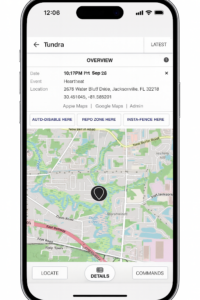
With GPS tracking, businesses can:
Locate assets: Access location
information for GPS-equipped trailers
and equipment.
Save time: Reduce manual searches
and unnecessary trips.
Improve visibility: Better understand
where tracked assets are located across
operations.
Support recovery: Access critical
location information when a trailer or
piece of equipment goes missing.
These everyday advantages make GPS a valuable operational tool, not just something
businesses turn to after a theft.
Cargo theft is no longer limited to someone breaking into a parked trailer. Theft schemes
can also involve fraudulent pickups, compromised shipping credentials, and criminals
posing as legitimate transportation providers.
In some cases, a trailer may leave a facility appearing to be part of an authorized
transaction.
Strong shipment verification procedures, accurate records, and employee awareness
remain essential to protecting valuable cargo.
GPS tracking adds another layer of visibility by helping businesses locate equipped
trailers and other tracked assets if something goes wrong.
While GPS cannot prevent every theft or replace proper security procedures, it can
provide valuable location information to support recovery efforts.
The best time to establish asset visibility is before something goes missing.
For businesses managing large trailer inventories, tracking costs can quickly become a
deciding factor in how many assets receive GPS protection.
When every device adds another monthly service fee, expanding tracking across an entire
operation can create significant recurring expenses.
Sarekon offers a different approach.
With zero monthly GPS fees on qualifying solutions, businesses can expand GPS tracking
across more trailers and equipment without continuously increasing their monthly
tracking expenses.
The advantage isn’t simply spending less money on GPS. It’s being able to protect more
of the assets your business depends on.
Instead of limiting tracking to only a few high-value trailers, businesses can explore
broader GPS strategies that provide greater visibility across their operations.
More assets visible. More inventory protected. Zero monthly GPS fees.
Every business manages its assets differently. Some trailers require permanently installed
tracking devices, while others benefit from more flexible placement options.
Sarekon offers wired, wireless, and rechargeable GPS solutions designed to accommodate
different asset types and tracking needs.
Whether you’re managing enclosed cargo trailers, equipment trailers, or other valuable
business assets, Sarekon helps make location visibility simple and accessible.
And while Sarekon may be a newer name to some businesses in the cargo and trailer
industries, we’re not new to GPS.
For 27 years, our team has worked in GPS and telematics technology, developing
solutions that help businesses locate, manage, and recover valuable assets.
That experience matters when choosing a GPS provider. Businesses need reliable
technology, flexible options, and a team that understands the importance of protecting
valuable investments.

October is also when many dealerships begin looking ahead to 2027.
More inventory and more deals can mean more opportunity, but they also mean more financed vehicles to manage. As portfolios grow, visibility needs to scale with them.
That makes this a good time to look beyond whether GPS devices are simply installed and ask whether the information coming from those devices is actually helping your team operate more effectively.
Can your team quickly understand what is happening with a financed vehicle? Can it see meaningful changes without digging through multiple systems? Can it use vehicle information to support everyday portfolio decisions?
Those questions will become even more important as dealerships prepare for another year of growth.
Every trailer and piece of equipment represents an investment in your business.
Maintaining visibility into those assets helps support daily operations and prepares your team to respond when something goes wrong.
As your business grows, your approach to GPS tracking should grow with it.
With flexible hardware solutions, 27 years of GPS and telematics experience, and zero
monthly GPS fees on qualifying solutions, Sarekon makes it easier to expand asset
visibility without adding unnecessary recurring costs.
Your cargo moves. Your visibility should too.
Protect More Assets Without Another Monthly GPS Bill
Discover how Sarekon’s wired, wireless, and rechargeable GPS solutions can help your
business improve asset visibility without adding unnecessary recurring expenses.
Schedule a Demo | (888) 726-3511 | Sarekon.com


